BAMRG Members Report
BAMRG Members Report - June 2025
Azerbaijan
Azerbaijan is located at the crossroads of Eastern Europe and Western Asia. Throughout its history it has been shaped by different empires, including the Persians, Romans, Arabs, Seljuks and the Mongols. Christianity first arrived in the region during the first century AD through the efforts of early Christian apostles, including Bartholomew and Thaddeus.
Islam became dominant after the Arab conquest in the seventh century. Under Russian imperial rule in the 19th century, Christianity resurfaced to a degree. Azerbaijan briefly declared independence in 1918 before becoming part of the Soviet Union in 1920. During Soviet rule, religious expression was heavily restricted. Thousands of people were killed in the 1930s during Stalin’s purges. In 1991, Azerbaijan regained independence. Today, Azerbaijan is a 97 per cent Islamic country.
Beginning in 1988, Azerbaijan and Armenia fought over the Nagorno-Karabakh region, which was populated by ethnic Armenians (Christian) but incorporated into Soviet Azerbaijan as an autonomous oblast in the early 1920s. The conflict can be divided into three main periods: the 1998 – 1994 Karabakh War, the 1994 – 2020 ceasefire, and the 2023 – 2024 conflict. In the end, Azerbaijan regained full control over Nagorno-Karabakh forcing the entire Armenian population to flee to Armenia.
In Azerbaijan, the number of Christians has increased from forty in 1991 to an estimated 6,000 today. In response to many requests, the Azerbaijan Bible Society is providing Azerbaijani churches and Christians with Bibles. Your gift to Bible a Month Regular Giving will help to support this project, which is vital as Bibles are needed to strengthen faith and to grow churches.
Prayer Points for Azerbaijan
Pray for logistical issues around the delivery of the Bibles to go smoothly especially through customs and for the Bibles to impact many lives.
Give thanks that the number of Christians has grown from 40 in 1991 to thousands today, and that there are new expressions of faith such as Christian music, literature, and poetry.
Pray that a long-term association of Christianity with Russian imperialism and Armenian enmity will begin to change.
Pray for believers in Azerbaijan, for the maturing of Christian leaders and for good fellowship among believers.
Pray more with us here.
FURTHER BIBLE MISSION PROJECTS
Dominican Republic
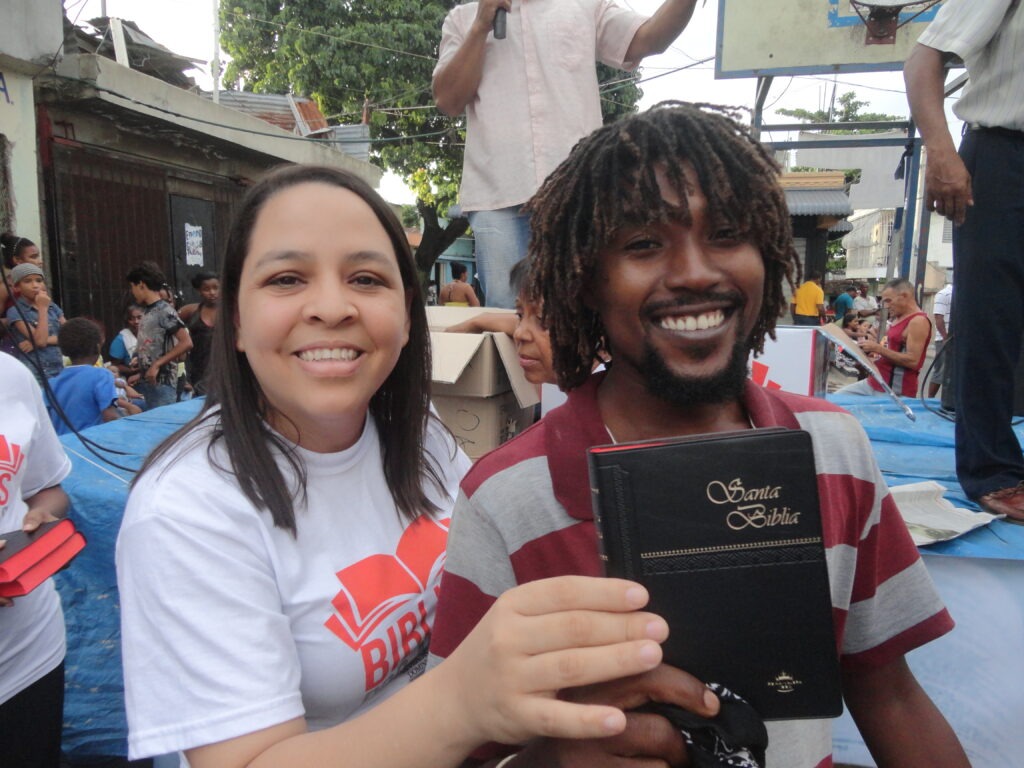
In 1492, the Dominican Republic was colonised by Spain. In 1795, Spain ceded it to France, before regaining control in 1809. In 1821, the colony declared independence but it was annexed by Haiti. In 1844, the Dominican Republic gained independence from Haitian rule.
The country faced internal instability, including a U.S. occupation (1916–1924), and the Trujillo dictatorship (1930–1961), followed by a period of democratic reforms. Christianity, particularly Roman Catholicism, has deeply shaped Dominican culture and society, and today 80 per cent of the population identify as Christian.
The Dominican Republic Bible Society is producing 6,000 Bible portions for the Deaf community in Sign Language. It is training church leaders in the need for inclusivity.
Lithuania
Lithuania emerged as a powerful state in the 13th century as the Polish-Lithuanian Commonwealth, controlling much of West Russia, Belarus, and Ukraine. In the 18th century, the Russian Empire absorbed it. In 1918, Lithuania declared independence before being occupied by the Soviet Union in 1940, then Nazi Germany, and finally re-occupied by the Soviets. In 1990, Lithuania gained independence.
In 1837, Christianity reached Lithuania after the conversion of the Grand Duke Jogaila prior to marriage. During Soviet rule, religious practice was heavily suppressed. Today, 79 per cent of the population identifying as Christian. The Bible Society of Lithuania is producing a new translation of the New Testament. It is translating Bible stories into Lithuanian Sign Language.
CUBA
In 1492, Cuba was colonised by Spain. Christianity in Cuba, particularly Roman Catholicism, began with Spanish colonisation. In 1898, Cuba became a U.S. protectorate, gaining formal independence in 1902. In 1959, Fidel Castro led a communist revolution, and Cuba became a one-party socialist state allied with the Soviet Union.
The Church held significant influence until the 1959 revolution, after which the communist government restricted religious activity and promoted atheism. In the 1990s, restrictions eased, and today, 58 per cent of the population identify as Christian.
The Cuban Bible Society is distributing Bibles to Christians in churches and encouraging Bible engagement. It is distributing Bibles to Cuban families suitable for all the ages in the household.
Kenya
Kenya’s history includes diverse indigenous cultures and trade along the Swahili Coast. In 1920, the former East Africa Protectorate became a British colony. This sparked resistance movements, notably the Mau Mau Uprising in the 1950s. In 1963, Kenya gained independence. A period of political unrest followed, until multiparty democracy was introduced in the 1990s.
Christianity in Kenya began with Portuguese missionaries in the 15th century, but widespread influence came in the 19th century through European missionaries, especially from Britain. Today, 85 per cent of the population identify as Christian.
The Bible Society of Kenya is distributing Bibles to marginalised children and youth. It is empowering pastors in low-income areas by providing training and Bibles.